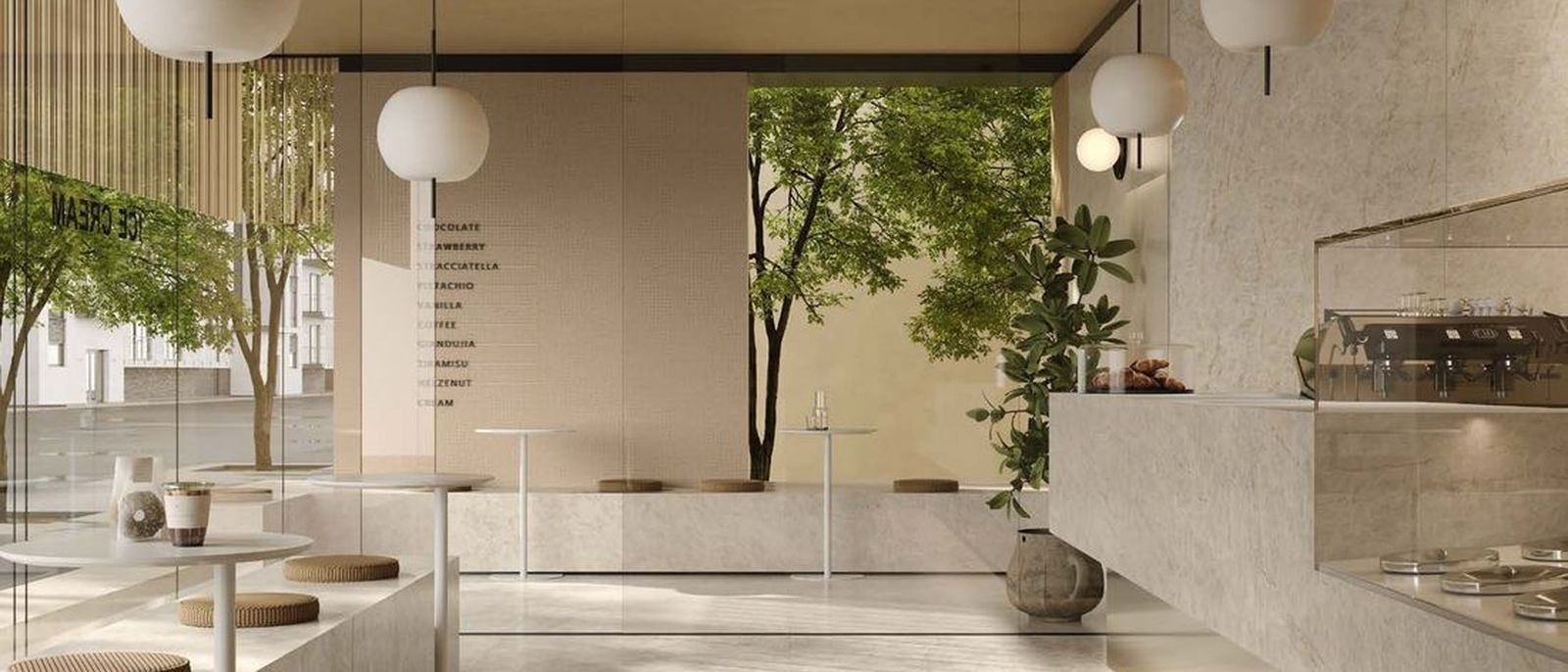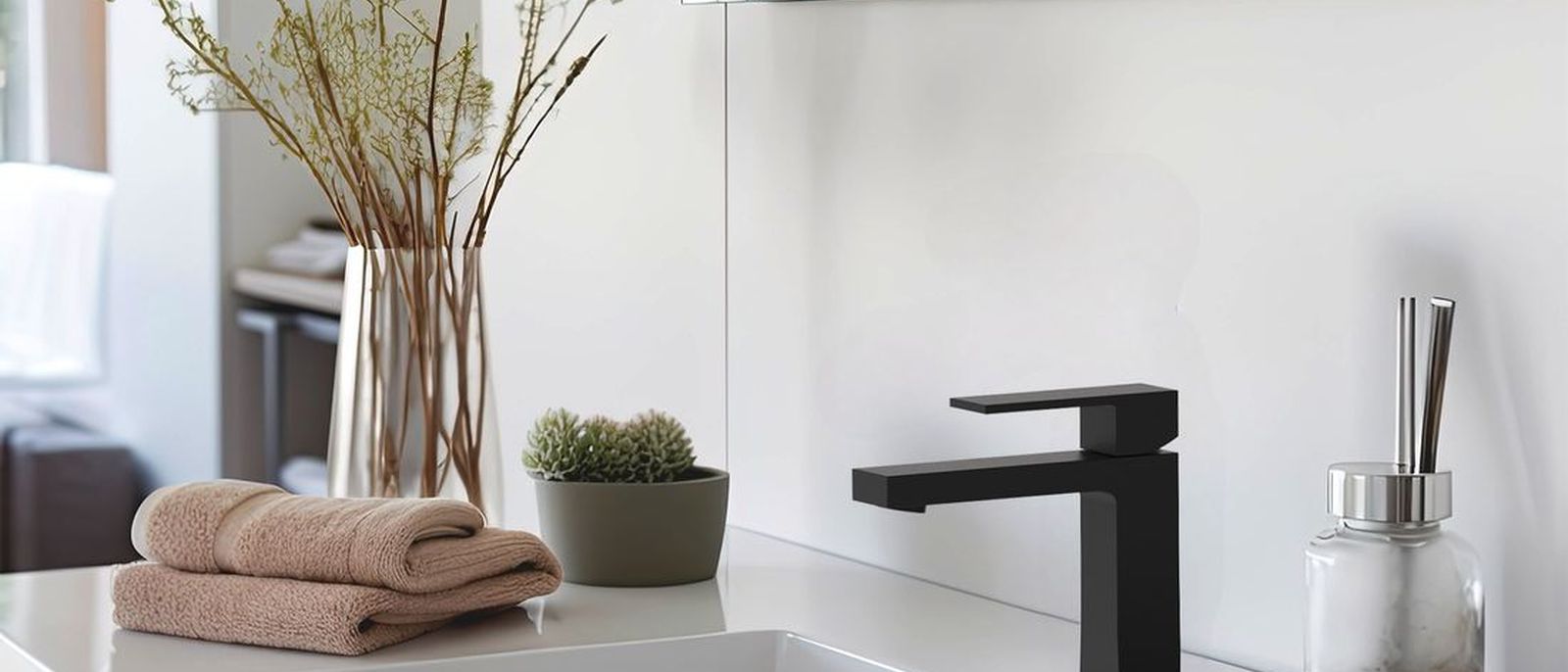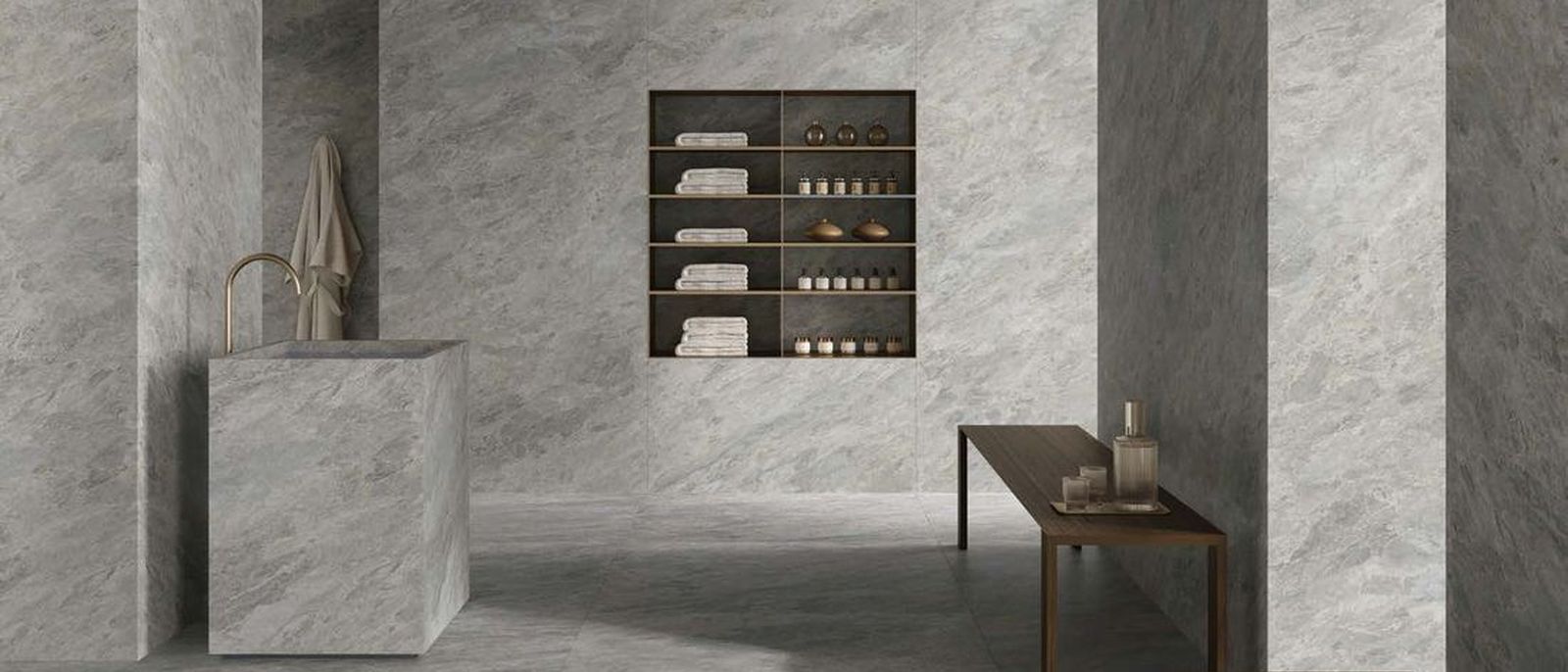
Nexion sits in our collection as a large-format surface house: porcelain slabs and surface collections in marble, stone, concrete and oxide finishes, in formats up to 1600x3200 mm and beyond. What that size unlocks is not simply a bigger tile — it is the ability to treat a wall, an island or a vanity as a single continuous piece of material. This guide explains where that matters, what book-matching actually is, and how to assess a slab honestly rather than from a photograph.
What the format makes possible
At 1600x3200 mm a single piece will clad most shower walls, wrap a kitchen island, or run a vanity top and its splashback without a joint. That is the real proposition: not a tile with fewer grout lines, but a surface with none at all across the area the eye actually reads.
The consequence is that the material's own pattern becomes the design. With a small tile, the grid dominates and the veining is decoration. With a slab, there is no grid — so the vein, the movement and the way it meets an edge carry the entire composition, and choosing the specific piece matters more than choosing the range.
Book-matching and vein-matching
Selected Nexion ranges offer book-matched and vein-matched pairs. Book-matching means two adjacent slabs are mirror images of one another, so the veining opens outward from the joint like the two pages of an open book. Vein-matching means consecutive pieces continue the same pattern in sequence, so a vein appears to run on uninterrupted across a wall.
This is what allows a feature wall or an island face to read as one piece of quarried stone rather than as panels. It has to be planned: matched pairs are ordered together, kept together, and installed in the intended orientation. Once a book-matched pair is split between two rooms, it cannot be recreated.
Marble, stone, concrete and oxide
The marble and stone finishes are where most residential specification starts, and they carry the practical advantage over natural stone: porcelain does not etch from lemon or wine, does not need sealing, and holds its colour under sunlight. For a kitchen island or a bathroom vanity in daily use, that difference shows up within the first year.
The concrete and oxide finishes serve a different intention — quieter, more architectural, and forgiving in a way polished marble is not. An oxide wall reads as a considered backdrop rather than a feature, which is often exactly what a room with strong joinery or a statement fitting needs.
How to judge a slab honestly
Three things cannot be assessed from a sample or a screen. Scale: a vein that looks dramatic in a 100 mm swatch may be almost invisible across three metres, or overwhelming. Light: a polished surface behaves completely differently under daylight, downlights and grazing light, and only the last of these reveals surface texture. Continuity: whether the pattern actually reads as one piece is only visible at full height.
This is the reason the Nexion slab lounge at our studio exists — slabs are displayed upright, at full size, under proper light, which is the only way a slab can be judged. Seeing two book-matched pieces standing together settles a decision in about a minute that photographs cannot settle at all.
Specifying it properly
Slab work is a fabrication job as much as an installation one. Mitred edges, sink cut-outs, drainage grooves and the joint positions on a tall wall are all drawn before anything is cut. Handling needs frames and suction lifters and a crew that works with the format regularly.
If you are weighing a slab surface against large-format tiles, our large-format guide covers the shared installation groundwork, and the surface solutions page sets out where each belongs. The other houses we curate from are listed on our brands page.